
Those Who Hope Are Transformed

Most Christians I know have felt stuck in their walk with God at one point or another. For some this lasts a month or two, but for others it can drag on for years. Why is this?

For those who have the Holy Spirit and regularly seek the Lord, it seems like growth should come more easily. Trees don’t always produce fruit as quickly as we’d like, but with the right soil and care, they do produce fruit.

It’s probably rare that a stalled spiritual life is the result of a single cause. And different people are different! But the Bible does help us ask some relevant questions.

Confidence Now

The apostle John wrote his first letter to explain how believers might have assurance of eternal life (1 John 5:13). In the middle of the letter, he discusses how to have confidence both now and when Christ returns.

One of the reasons believers can have confidence in their salvation now is objective: God has loved us and called us his children.

See what kind of love the Father has given to us, that we should be called children of God; and so we are. The reason why the world does not know us is that it did not know him. Beloved, we are God’s children now (1 John 3:1-2)

John points to the facts of the gospel and the words of Jesus for this evidence. What he has written in his Gospel account is more than enough to justify these claims. The “kind of love” the Father has given stretches from a cosmic scale (”In the beginning was the Word…”) to the washing of feet, from welcoming notorious rebels to dying at the insistence of religious leaders. It’s the kind of love that cannot remain in the grave—the stone must roll away.

John also teaches that godly actions come from godly people: “If you know that he is righteous, you may be sure that everyone who practices righteousness has been born of him” (1 John 2:29). “Practicing righteousness” cannot mean mere external conformity to some list of rules, as true righteousness involves desires, motives, and worship.

Confidence Later

John wants his hearers to have confidence in their salvation when Christ appears, not only in the present time.

John confesses he does not know exactly what we will be like when Christ appears, but what he can say for sure is lovely: “when he appears we shall be like him, because we shall see him as he is” (1 John 3:2).

Make sure you grab onto this promise with both hands. We shall be like him. These bodies and minds of ours that are shot through with sin and shame will be transformed. The curse—which has invaded our every cell—will be no more. God is holy and glorious, and we shall share in that holiness and glory!

I’ve written a lot in the last few years about hope. My shorthand definition of biblical hope is that hope is the joyful expectation that God will keep his promises.

John does not beat around the bush—he writes to give hope: “And everyone who thus hopes…” (1 John 3:3). When John describes the promise of God to be fulfilled when Christ returns, he’s calling us to hope! Believe this promise, picture it being fulfilled, reflect on just how wonderful that fulfillment will be.

Hope is powerful, and it has natural consequences. “And everyone who thus hopes in him purifies himself as he is pure” (1 John 3:3). Those who hope in this way will purify themselves. Note that this requires and assumes that we understand how God is pure and how we aim for that purity.

Another word John uses for purification is abiding in Christ. And he counsels that abiding in Christ—or purifying ourselves because of our great hope—gives us confidence when he returns.

And now, little children, abide in him, so that when he appears we may have confidence and not shrink from him in shame at his coming. (1 John 2:28)

As we grow in godliness, we grow in our future confidence before Christ. By the power of the Spirit, and because we are forgiven, we will increasingly say no to sin. We will not shrink back from him in shame.

Look to His Promises

If you feel stuck in your walk with God, if you feel you’ve reached a plateau or are even losing your footing, the apostle John has a word for you. Lean into hope.

It may be that you’re not growing because you’re not hoping. The Bible doesn’t call us to focus on the future to the exclusion of the present, but our hope is clearly forward-looking.

Have you meditated on the future? Have you let your sanctified imagination loose on the idea of new bodies, a new earth, and new heavens? Have you pondered what it will be like to see God as he is? To be like him?

These are not idle daydreams; this is not a frivolous thought experiment. If you want to grow in purity, in your God-likeness, hope like this might be just what you need.

Post credit | Photo credit

Links for the Weekend (2026-08-14)

Each Friday, I’ll post links to 3–5 resources from around the web you may want to check out.

When God’s Plans Seem Inconsistent With His Promises

Kirsten Black writes about how the story of Abraham’s willingness to sacrifice Isaac reveals the nature of faith. God will keep his promises even when we can’t see how that may happen.

Enduring faith trusts the character of God, even when his actions defy logic. Lasting faith believes who God says he is, even when experiences suggest otherwise. Sincere faith accepts that we cannot see the full picture. We can be certain, however, that we have a faithful God who knows and understands every aspect of what he is doing. He sees the beginning, the end, and everything in-between.

Cruising Downstream, Laboring Upstream

Tim Challies uses an analogy about canoeing on a river to help us understand growing in holiness.

You may know from experience that it is easy to take a boat downstream and much harder to take it back up. You certainly know from experience that it is easy to follow sin downstream and much harder to change your course to pursue holiness. As long as you go with the flow of your own desires, the ways of the devil, and the movement of the world around you, life is easy. You can stow your paddle and simply coast. But when you choose to turn toward the Lord, when you decide you will labor toward the Heaven he has secured for us rather than coast to Hell, you quickly learn that you are in for a struggle.

How to Fight Laziness

John Piper explains a proverb about laziness and points to our hope of transformation.


Note: Washington Presbyterian Church and the editors of this blog do not necessarily endorse all content produced by the individuals or groups referenced here. 

Training That Only Grace Provides

My years as an athlete ended in high school. I was decent in one sport, decidedly below average in a few others, and quite content to leave formal competition behind at graduation.

My high school coaches didn’t fit the stereotype of an athletic trainer. They were encouraging, supportive, and (mostly) kind. Perhaps because of movies and television, I picture a trainer differently: intense, aggressive, and maybe a little bit mean.

What comes to your mind when you think of training? Does training have any relationship to Christian discipleship? In this post we’ll learn about the trainer Paul describes for all believers, regardless of fitness level.

Grace is a Trainer

I’ve recently been turning the following passage over in my mind.

For the grace of God has appeared, bringing salvation for all people, training us to renounce ungodliness and worldly passions, and to live self-controlled, upright, and godly lives in the present age, waiting for our blessed hope, the appearing of the glory of our great God and Savior Jesus Christ, who gave himself for us to redeem us from all lawlessness and to purify for himself a people for his own possession who are zealous for good works. (Titus 2:11–14)

God’s grace is training us. That may sound surprising, as many people wouldn’t put grace in the role of trainer. Before studying this passage, I’d list several aspects of the Christian life before grace when thinking of training, including law, God’s discipline, and the example of other believers.

But Paul lands on grace as our trainer. To understand Paul’s logic, let’s look just one chapter later in this letter.

But when the goodness and loving kindness of God our Savior appeared, he saved us, not because of works done by us in righteousness, but according to his own mercy, by the washing of regeneration and renewal of the Holy Spirit, whom he poured out on us richly through Jesus Christ our Savior, so that being justified by his grace we might become heirs according to the hope of eternal life. (Titus 3:4–7)

We are not saved by our works, but by God’s mercy. We have been justified by God’s grace and have therefore become heirs of God. We are new people, through the regeneration of the Holy Spirit.

Through God’s favor, we now have an identity we do not deserve and would never choose. We are heirs of God.

God’s grace trains us because reflecting on our new identity is confrontational. His grace is contrary to our expectations, our nature, and even our basic notions of cause and effect. When we encounter God’s grace in this way, it forces us to grapple with what is true about God, us, and the way God really operates.

A trainer might force us to get out of bed to run when we’d rather sleep. The moral and religious path of least resistance is one of works and consequences. Grace, as our trainer, wakes us up and puts the uncomfortable (and wonderful) truth in our faces: we are justified by grace.

Training to Renounce and Live

Training always has a goal. Grace is “training us to renounce ungodliness and worldly passions, and to live self-controlled, upright, and godly lives in the present age.” In other words, God’s grace trains us to live as the new people we are.

The word “renounce” has teeth. It is different than “reject” or “refuse.” Renounce carries the idea that this was part of me and my lifestyle—but no more. To renounce is to intentionally put what I was behind me. Because we are justified, heirs of God, we can say “no more” to all the ungodliness and worldly passions that defined us.

Grace also trains us to live. This letter to Titus is full of what a “godly” life is like. (See Titus 1:5–9; 2:1–10; 3:1–2; 3:9–10.)

The renounce/live training that grace provides is similar to the put off/put on pattern of repentance that Paul describes in Ephesians 4:17–32. Because this is training, this renouncing and living is something Christians learn and practice throughout their lives.

Waiting For Our Blessed Hope

Part of our new living is “waiting for our blessed hope, the appearing of the glory of our great God and Savior Jesus Christ.”

Most of us don’t like to wait for anything, so we might bristle to learn that waiting is part of our Christian calling. Yet we know exactly what we’re called to wait for: the appearing of the glory of Jesus.

Paul also tells us why we should look forward to this appearing: because of what Jesus has done. Jesus “gave himself for us to redeem us from all lawlessness and to purify for himself a people for his own possession who are zealous for good works.” When Jesus gave himself for us there were (at least) two outcomes in mind: to redeem his people and to purify his people.

If Jesus gave himself for us for these world-altering ends, why wouldn’t his people eagerly long to see his glory?

The End of Our Training

All training is for a purpose—for an event or an outcome or a season of competition.

Similarly, grace trains us toward an end. We hope for the appearing of Jesus. When we see him, all will be made whole, all will be new. God’s children will receive their promised inheritance.

Paul refers to this as our “blessed hope.” Our progression in the Christian life will choke and sputter without this hope fueling our engines. There are many ways we can grow in hope, but hope is not optional for believers.

But we are not alone as we seek to grow. God’s grace is training us.

Post credit | Photo credit

Links for the Weekend (2025-05-23)

Each Friday, I’ll post links to 3–5 resources from around the web you may want to check out.

How do I find hope when I struggle with persistent sin?

I appreciated the answer to this question by CCEF counselor Lauren Whitman. She talks about the struggle against sin and points us to hope in God’s mercy. (This link is to a video, and there is a transcript on the page as well.)

So where sin is persistent, our Jesus is more so. When sin is persistent, Jesus’s love will not stop. He will persist in remaking you. He will prove to be doggedly more persistent than your sin. He is the most persistent person in the universe and he will have his way with you, and his ways are good, they’re for your good, and he will prevail over your sin. So every day, look to the one who has loved you and loves you with a persistent love. He is not giving up on you, and he never will. 

How to Support the Caregivers in Your Church

If you’ve never been a caregiver for someone who needs long-term help, you might not know the best way to support such a person. I’m glad that Simonetta Carr wrote this post to highlight some of the most needed areas.

The best thing to do is to be present as faithful friends, ready to stick around, listen, and learn. Getting involved in the lives of caregivers and their loved ones may seem like a sacrifice, but it’s well worth it for everyone involved. If we are convinced that “the body does not consist of one member but of many” (1 Cor. 12:14), and each is necessary for the building up of the church, we will treat each other as such and—in the process—grow in maturity, love, and wisdom.

The Windows

Our poem of the week: The Windows, by George Herbert. This poem, written by a Christian poet in the 1600s, is about how our words must be combined with our life to point to God’s grace.


Note: Washington Presbyterian Church and the editors of this blog do not necessarily endorse all content produced by the individuals or groups referenced here. 

Links for the Weekend (2025-03-21)

Each Friday, I’ll post links to 3–5 resources from around the web you may want to check out.

The Best Source of Stability on an Emotional Roller Coaster

Lois Flowers encourages us to cling to the anchor of God’s character when we’re in life’s storms.

What is true about God doesn’t change according to our circumstances. He is the same yesterday, today and forever. As believers, our names are engraved on the palm of His hand. He loves us with an everlasting love. He goes before us and is with us. He will never leave us nor forsake us.

These are truths, not clichés. They are not metaphorically hidden in the pages of scripture. They are spelled out clearly and plainly.

Even though we may sometimes think otherwise, God’s love does not cease to apply to us when something in our lives goes wrong. We are not the exception to His promises, His truth or His sovereignty. When trials come, as He explicitly promised they would, His character does not bypass us or our loved ones.

In Sanctification, Where You’re Going Is More Important Than Where You Are

Kevin DeYoung wrote some helpful words for us on how we progress in holiness.

Which brings us to one of the most important axioms about holiness: when it comes to sanctification, it’s more important where you’re going than where you are. Direction matters more than position. Your future progress speaks louder than your present placement. So cheer up: if you aren’t as holy as you want to be now, God may still be pleased with you because you are heading in the right direction. And be warned: if you aren’t as holy as you used to be, God probably isn’t impressed with yesterday’s triumphs when for the last few months you’ve done nothing but give up.

March Sonnet

Our poem of the week: March Sonnet by Chelsea Fraser. This is a poem about the arrival of spring (with a hint of resurrection thrown in too).

On the WPCA Blog This Week

This week on the blog we published an article I wrote called Reading the Bible for the First Time. If you haven’t already seen it, check it out!


Note: Washington Presbyterian Church and the editors of this blog do not necessarily endorse all content produced by the individuals or groups referenced here. 

Links for the Weekend (2024-12-06)

Each Friday, I’ll post links to 3–5 resources from around the web you may want to check out.

We Need Advent

T. M. Suffield writes about how the waiting of Advent is just the thing we need.

Advent can help us. This is a season of darkness, focused on the second coming of Jesus. It’s a time of waiting. It’s a time to really feel the tension of living in the Between, this suspended moment between what was and what will be. The Church are a people of the Between, a people of gloaming, of the time when it’s neither night nor day, the time between the times.

You’re Exactly As Holy As You Want To Be

This article from Tim Challies is a sobering reminder of our still-being-sanctified wills. We now have the ability to resist sin, but we often put up little fight. This should not only sober us, but our unity with Christ should give us hope.

Yet that’s only partially true. There’s another sense in which each of us is exactly as holy as we want to be. How is that the case? Because there is no one who can force us to sin and nothing that can force us to fail to do whatever is righteous in any given moment. There is no one who can keep us from deriving spiritual growth and benefit from any of the circumstances of our lives. No one, that is, except ourselves. If we ever wonder who is hindering our holiness, we don’t need to look any further than the closest mirror.

Six Questions Our Children Have that Demand Answers

Here’s a look at the sorts of questions our children ask as they mature. The author provides some advice on helpful answers we can supply.


Note: Washington Presbyterian Church and the editors of this blog do not necessarily endorse all content produced by the individuals or groups referenced here. 

Links for the Weekend (2024-03-08)

Each Friday, I’ll post links to 3–5 resources from around the web you may want to check out.

Our limits are a gift from God

We don’t often thank God for our limitations, but Aaron Armstrong argues that might just be what we need to do.

Even more than reminding us that we are not God, our limits encourage us to see the goodness of life together. Of being part of a community that bears one another’s burdens, weeps with those who weep, and rejoice with those who rejoice. People with whom we can share our weaknesses, and God uses to carry us forward.

When the Walk Becomes a Crawl: One of the Most Hopeful Reminders I’ve Read about Sanctification

Justin Taylor shares an excerpt from a David Powlison book that gives great encouragement about the speed and direction of sanctification.

But, in fact, there’s no formula, no secret, no technique, no program, no schedule, and no truth that guarantees the speed, distance, or time frame. On the day you die, you’ll still be somewhere in the middle. But you will be further along.

10 Reasons the Old Testament Matters to Christians

Christians don’t often need to be convinced of the value of reading the New Testament. But the Old Testament is a different story. Here’s a list of ten reasons the Old Testament really matters, with great explanations.

To understand the Old Testament fully, we must start reading it as believers in the resurrected Jesus, with God having awakened our spiritual senses to perceive and hear rightly. As Paul notes, Scripture’s truths are “spiritually discerned” (1 Cor. 2:14) and only through Christ does God enable us to read the old covenant materials as God intended (2 Cor. 3:14). This, in turn, allows our biblical interpretation as Christians to reach its rightful end of “beholding the glory of the Lord” and “being transformed into the same image from one degree of glory to another” (2 Cor. 3:14–18). Thus, we read for Christ.

On the WPCA Blog This Week

This week on the blog we published an article I wrote called What My Children Taught Me About Grace. If you haven’t already seen it, check it out!


Note: Washington Presbyterian Church and the editors of this blog do not necessarily endorse all content produced by the individuals or groups referenced here. 

Links for the Weekend (2023-08-11)

Each Friday, I’ll post links to 3–5 resources from around the web you may want to check out.

You Must Be Weak to Be Sanctified

This is a good discussion of weakness and sanctification.

Why does the apostle reference weakness? Because he’s convinced coming to grips with one’s limits and depending on the Spirit is how sanctification works. After all, God does the sanctifying work. That’s the second qualifying clause: “For it is God who works in you, both to will and to work” (v. 13). We work out our salvation fearfully and humbly, knowing we’re not strong enough—but God is.

The Godliness of a Good Night’s Sleep

Like the author of this article, I too once associated exhaustion with living for the Lord. How good to be corrected! Read about how we can relate to sleep as Christians.

When we leave our beds to walk in love, we do not leave our God. His help is stronger than sleep’s healing, his wisdom deeper than sleep’s teaching, his generosity greater than sleep’s giving. He can sustain us in our sleeplessness and, in his good time, give again to his beloved sleep.

How to Become a Tech-Wise Family

This article is a distillation of Andy Crouch’s book, The Tech-Wise Family. Read about three fundamental choices and ten commitments that will help your family grow in wisdom as you interact with technology.

On the WPCA Blog This Week

This week on the blog we published an article I wrote called The Difference Between Optimism and Biblical Hope. If you haven’t already seen it, check it out!

Thanks to Phil A for his help in rounding up links this week!


Note: Washington Presbyterian Church and the editors of this blog do not necessarily endorse all content produced by the individuals or groups referenced here. 

The House No One Could Love

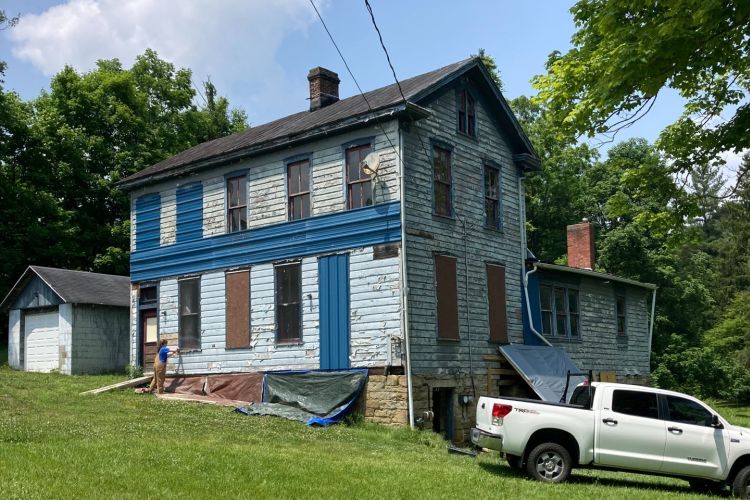
Photo of old farm house

It’s a beautiful house—good bones, as they say. I mean the roof has gone bad, and the walls are bad, and some of the floors are bad, and the foundation is bad. But other than that, it’s a dream! 

The first time we walked through the house, I could practically see our realtor shudder. It was uninhabitable. No bank would touch it with a mortgage—what an awful investment! It looks like it might fall over at any moment! It’s not worth saving. The merciful thing to do would be to bulldoze it and put it out of the neighborhood’s misery. 

Why did we buy a crumbling house that any reasonable person would turn up their nose at? I could cite the history of the house, the size of the rooms, the acreage. At the heart though, we bought it because we want to save it, and we want to save it because we love it. 

Loved “As Is”

There’s something redemptive in saving this old, decrepit house. It was made to be beautiful, and we want to make it beautiful again. In that way, this project reflects the heart of our Father, who “so loved the world, that he gave his only Son, … in order that the world might be saved through him” (from John 3:16–17). 

Before we were redeemed by Christ, we had nothing to commend us to God—not even “good bones.” As Paul wrote to Titus, “For we ourselves were once foolish, disobedient, led astray, slaves to various passions and pleasures, passing our days in malice and envy, hated by others and hating one another” (Titus 3:3). We were, by all human measures, not worth saving. 

But God did save us! At great personal cost, with sweat and tears and precious blood, Jesus redeemed even me. He didn’t examine me closely and determine that there’s something here he could work with, or do a cost-benefit analysis to see if the work put into me would be worth the outcome. No, God saved me out of his own love and mercy.

Paul continued, “But when the goodness and loving kindness of God our Savior appeared, he saved us, not because of works done by us in righteousness, but according to his own mercy, by the washing of regeneration and renewal of the Holy Spirit” (Titus 3:4-5). 

In love Jesus bought us—“as is,” you might say. He wanted you and me, both individually and collectively, to be his treasured possession. 

Completed on Schedule

This beautiful, outrageous act of redemption is not the full height of Jesus’s plan for us! He is also, at this moment, currently renewing us. 

Jesus places his Holy Spirit in each person who believes. Lovingly, painstakingly, the Spirit is crafting each one of us into pure, spotless saints. We are described as “living stones [that] are being built up as a spiritual house” (1 Peter 1:23), which resonates particularly right now as Zack is repairing the old foundation stone by stone. 

The Spirit’s work is not always—in fact, not often—glamorous. I took a mallet to a wall at the house recently. Plaster chunks and wood lath splinters flew, and in an hour or two the wall was reduced to studs and rubble. Our growth as believers can feel that way, shattered and broken. Aren’t we supposed to be growing from one degree of glory to another? Why does it hurt? Why is there so much dust?

Zack and I aren’t naive. We know that this sad, broken house will take years and dollars to bring back to life. It might take more of both than we have. The whole thing could fall down or burn to the ground before we ever get to see it to completion. (Probably not though, right?)

The God who made the world is a more sure builder. “I am sure of this, that he who began a good work in you will bring it to completion at the day of Jesus Christ,” wrote Paul (Philippians 1:6). 

Not one of God’s new creations will arrive in heaven behind schedule. The Holy Spirit works patiently, individually, thoughtfully, sometimes one room at a time, sometimes with several projects going at once, sometimes narrowly focused on one particularly malignant problem. But rest assured, at the day of Jesus Christ, you’ll have a fresh coat of paint, a new front porch, and the only strong foundation.

Photo by the author

Finding Hope in Slow Sanctification

Have you ever felt like sanctification is too slow? I have. This is a common (and healthy) tension. For on the one hand, yes, God hates sin and we are called to live holy lives. On the other hand, no Christians on earth are completely free from the old self.

But there are some pitfalls here—some unhealthy places this tension can take us. Despair, frustration, and giving up are temptations we all feel from time to time. How can we avoid these traps? The best way is to focus on God’s role in sanctification.

The Temptation to Despair

God is not trying to lead us to despair. Sanctification is often a painfully slow process. I have grown impatient as I appear to be “left in my sin” with little to no evidence of growing holiness in my life. “I thought God hated sin,” I might say, “so why doesn’t he get rid of it?” I am aware of my blindness, but I don’t see any evidence of spiritual growth. But I’m superimposing my plan over and against God’s plan, as if to say “it would obviously be better if…” and failing to take the time to be still and know that he is God (Psalm 46:10). 

This despair can undermine our assurance of salvation. “Am I truly saved at all?” My only recourse is to trust, despite not seeing, that Christ is at work (Philippians 1:6) and, for some reason, taking his own sweet time. We were never saved because we were good. Remember, sanctification is founded in Christ and his obedience, not us and our weakness.

The Temptation to Frustration

God’s slowness can also become frustration, which is a pride issue. Often this is less about how slowly God works in us and more about how slowly God seemingly works in others. “Our country is going down the tubes. If only Christians in this country would…[fill in the blank]” or “my church would give more money if they actually believed what they say they believe.” Do other Christians need to work out their salvation? Yes (Philippians 2:12). But we can take it too far and become critical of the work of God himself. Again, this is an overemphasis on humanity’s role in sanctification and implies that people are hindering God. Nope, sorry. Doesn’t work like that. 

We are assured that Christ will bring his work to completion (Philippians 1:6) in his time. Becoming frustrated or angry puts my plans ahead of God’s and is unloving to the church. Everything is on track, and we are to “count the patience of our Lord as salvation” (2 Peter 3:15), realizing that he is still building his kingdom (Matthew 16:18)!

The Temptation to Indulgence

Unfortunately, God’s patience can also manifest in ungodly indulgence. This is a particularly dangerous pitfall which twists the patience of our Lord into permission to sin. “Oops, I guess that was just a bit of the old self” or “no one is perfect.” This is obviously wrong when I say it, for it presumes upon the sacrificial work of Christ (Romans 2:4). Nevertheless, it can creep into my life in more subtle ways, such as with a particular sin or for a particular season of life. And it creeps in so easily because it has a grain of truth to it. Yes, we will always struggle with sin on this side of eternity, and yes, in his divine purpose God has allowed sin to persist in believers. 

But, a believing heart will never be comfortable with sin again (Ephesians 4:22–24). The struggle must continue. This is key; a believer may struggle with recurring sin for the rest of their life, and the sin itself may look identical to that of an unbeliever, but the Spirit of God will never abandon the believer to feel at home in sin (John 16:7–11). A believer with a new heart takes after the character of God, and God hates sin (Romans 6:11).

What is Truly Valuable

So when our sanctification seems slow, it may be because we still have a lot to learn about what is valuable to Christ. We can become obsessed with a particular sin while Christ has bigger fish to fry. He may be working in us on a more fundamental level.

And the kingdom of heaven is not about you. It includes you, but it’s not all about you. So cultivate a heart of gratitude that you are included, and the fruit will be selfless love and service to others, without regard to their degree of sanctification.

Finally, know that there is a fire in you. The Spirit is alive and active in tectonic (powerful but often invisible) ways. Consider that the Scriptures make sense to you, you’re convicted of your sin, you are interceded for, works are prepared for you (and you for them), prayer to the Father is open to you in Christ, and a peace which passes understanding is yours.

When we seek to understand what is valuable to the kingdom of heaven, we start to see more and more of the beautiful work of Christ all around us and in us. Soon there is no room for despair because we see the fingerprints of God in our lives. A growing love for God’s people prevents our self-righteous frustration as we celebrate the small victories and realize they’re not that small after all. And we find that the new self takes on new life, caught up and pulled along by the hope and excitement of the gospel, leaving behind the old self where sulking in sin simply makes no sense anymore.

Photo credit