
Links for the Weekend (2022-09-09)

Each Friday, I’ll post links to 3–5 resources from around the web you may want to check out.

Money’s Not the Problem

Paul Tripp reflects on problems that we have with money, and what those problems can tell us about deeper matters.

Your financial life is always determined more by the desires of your heart than by the size of your income. To the degree that you ask money to provide for you what it was never meant to provide, to that degree you will find it very hard to be careful and disciplined in your use of money. Money can’t buy you a satisfied heart, money can’t buy you peace and happiness, and money can’t buy you a reason to get up in the morning. Money isn’t meant to be your source of comfort when you are hurting or of hope when you are feeling discouraged. Money can’t and was never intended to give you life. To ask money to do any of those things will always lead to money troubles.

The Messy Home of Blessing

Raising children can be really hard. This article reminds us why that hard work is worthwhile, despite what others might say.

Whenever God gives a child, he’s entrusting us with a precious and eternal heritage — a new life that will never end, and that, Lord willing, will grow to change and shape the world in all kinds of ways (maybe even having children of their own). Their impact on eternity will easily outweigh whatever work the world holds up as more meaningful and consequential.

Jesus Wants You to Know You Are Weak

Even Christians need to be reminded that there is no such thing as self-reliant Christianity.

Why highlight this point if we are already gospel people? Because we need constant reminders. Jesus reminded His disciples that they were already clean because of the word he had spoken to them (John 15:3). This motley crew of ragamuffins didn’t have it all together and neither do we. We are so forgetful. We often do our devotions and move into the workday as though the weight is completely on our shoulders. We treat our vocations, our hobbies, our parenting, and sometimes even our ministries as though we don’t really need much help. We’re like the adopted child who keeps trying to prove to his parents that he is part of the family.

On the WPCA Blog This Week

This week on the blog we published an article written by Caroline Higginbottom called Toward Mending a Divided World. If you haven’t already seen it, check it out!


Note: Washington Presbyterian Church and the editors of this blog do not necessarily endorse all content produced by the individuals or groups referenced here. 

Toward Mending a Divided World

Everywhere I look, I see divisions. There are lines drawn between people, pitting us against each other because of skin color, finances, gender, political party. Even in the church, we put up boundaries to keep from mixing with people who are different. I lament the way we are separated. I’m tired of it.

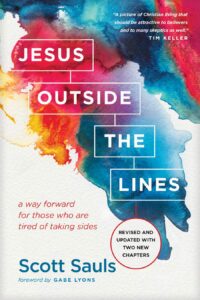
So, when I found Jesus Outside the Lines, I began reading it immediately, finished it in a day, and immediately wanted to hand a copy to everyone I know.

This fantastic book, written by Pastor Scott Sauls, gently leads us away from an us-against-them mindset and toward loving our neighbors despite our differences. He begins with an introduction that reminds us of Jesus’s call to love all people, even those who do not love us. He shows how kindness to people who do not agree with us flows naturally from God’s mercy and compassion to us.

Sauls addresses two different ways in which we must love across divisions, and these are the book’s two parts: within the body of Christ and outside of it. In each section are several chapters addressing particular issues that are difficult for Christians.

The first section covers loving our siblings in Christ across internal borders. It includes chapters addressing political and economic differences, among others, and how we must love people who voted for the other candidate or who earn more or less than ourselves. It is equal parts exhortation and encouragement. It is easy to say we must love our family; actually doing it can be difficult!

The path is harder still in the second section, because we are also meant to love those who do not believe as we do. This part addresses far more subjects, because there is so much to keep in mind when we talk to non-Christians. Should we affirm or critique? Should we be hopeful or realistic? What do we say when we are called hypocrites? How do we talk to those outside the faith about chastity?

Sauls doesn’t pretend to have all the answers, but rather helps the reader think through this important question: How do we love our neighbors, especially when we do not agree with them? The question is crucial since we will disagree with nearly everyone on one point or another. As people of God, we must treat each person with loving kindness, regardless of their beliefs.

The majority of people I interact with during the week are not Christians. It can be challenging to relate to classmates who center their lives around something that is not God, and sometimes this fundamental difference threatens to divide us. But I don’t want this to happen; I care about many of them, and I want to be someone people can count on to listen when they need to talk, to be kind when they are hurting. I want God’s light to reach them. This book provided guidance about the confusing mess of human relationships in light of God’s word and his love for us. It gave me permission to affirm and encourage non-Christians around me and to be friends with them. It also reminded me that critique, not criticism, is sometimes the most loving thing to do, and I ought to do so with an attitude of gentleness, not judgement. 

If you want to learn how to talk to people who aren’t (yet) believers or how to handle politics with other Christians, Jesus Outside the Lines is a great resource. It would be valuable for anyone who wants to build friendships with people who don’t agree on every issue, whether inside or outside the church.

Links for the Weekend (2022-09-02)

Each Friday, I’ll post links to 3–5 resources from around the web you may want to check out.

Sometimes I Struggle With the Bible

As Christians we know that we should read the Bible, but sometimes that feels like a tall task. Scott Sauls confesses the difficulty he has reading the Bible at times, but explains why he keeps at it.

Indeed, honest Bible readers—even skilled teachers of the Bible like C.S. Lewis—have found parts of it difficult, puzzling, mystifying, and even offensive. As much as we can rejoice in, get inspired by, and find comfort in certain parts of the Bible, other parts will disturb us—namely, the parts that contradict our feelings, instincts, hopes, dreams, traditions, and cultural values. I recently saw a quote that said, “Men do not reject the Bible because it contradicts itself. They reject it because it contradicts them.”

Why Does Justice Matter?

We may mean different things when we refer to “justice,” but that doesn’t mean we can ignore it. Jonathan Noyes tells us why justice should matter to Christians.

Justice is a universal moral principle, and it’s an objective moral good. It’s the single best word to capture God’s purpose for human conduct, individually and corporately (i.e. governments). The standard of what’s just and unjust is not a matter of personal opinion or preference. In this way, justice is a category of truth, with an important difference. Standard truth claims correspond to what is. Justice corresponds to what ought to be. Justice tells us what should be. 

The Problem with the Self-Help Movement

What’s the difference between self-help and sanctification? Jen Wilkin has a good, short video explanation.


Note: Washington Presbyterian Church and the editors of this blog do not necessarily endorse all content produced by the individuals or groups referenced here. 

Links for the Weekend (2022-08-26)

Each Friday, I’ll post links to 3–5 resources from around the web you may want to check out.

Why We Sleep (And the God Who Doesn’t)

Nick Tucker reflects on David’s ability to sleep while in danger and God’s inability (!) to sleep.

To think about God’s greatness, we naturally tend to talk about what God can do. We, however, are going to consider what God can’t do—and when you realise what God can’t do, his greatness might just blow your mind.

Senior Saints, We Need You

This is a great encouragement for all of us to care for and learn from our older brothers and sisters in the faith.

It’s time to step up our efforts at ministering to (and with) these older brothers and sisters. They have so much to contribute to the church. “Wisdom is with the aged, and understanding in length of days” (Job 12:12). But they need help discerning how best to mature in faith and practice as their bodies decline. They need encouragement to finish their race with endurance, resilience, and joy.

Slow to Anger

Here’s an encouraging meditation on God’s patience, particularly as it is captured in the phrase “slow to anger.”

If we were God in heaven, we would have grown impatient with people like us long ago. Our anger rises quickly in the face of personal offense. Our frustration boils over. Our judgments readily fire. And apart from the daily renewal of our minds, we can easily measure God “by that line of our own imaginations,” as if his thoughts matched our thoughts, and his ways our ways.

On the WPCA Blog This Week

This week on the blog we published an article I wrote called What the Holy Spirit Does for Us. If you haven’t already seen it, check it out!


Note: Washington Presbyterian Church and the editors of this blog do not necessarily endorse all content produced by the individuals or groups referenced here. 

What the Holy Spirit Does for Us

For many Christians, the role of the Holy Spirit in our lives is unclear. We have heard many stories of excess, of churches either ignoring the Spirit or focusing almost exclusively on him and his gifts. If we affirm the Trinity and want to understand and celebrate the work of the third Person, how should we proceed?

Romans 8 is not a bad place to start! It is full of references to the Holy Spirit.

But, because the chapter is so full of these references, we need an entry point. As we look closer, two of the references to the Holy Spirit stand out.

Twice in Romans 8 we are told that “the Spirit himself” does or accomplishes something. This phrase is emphatic, designed to make us look up from our coffee and take notice. The Spirit does not contract these jobs out to others, he does them himself, intimately involved in this work for us.

The Spirit Bears Witness

This phrase first occurs in verse 16.

For you did not receive the spirit of slavery to fall back into fear, but you have received the Spirit of adoption as sons, by whom we cry, “Abba! Father!” The Spirit himself bears witness with our spirit that we are children of God, and if children, then heirs—heirs of God and fellow heirs with Christ, provided we suffer with him in order that we may also be glorified with him. (Romans 8:15–17, emphasis mine)

When the Spirit “bears witness” with our spirits, he is reminding us—testifying to us—that we are children of God. Why would we need such reminding? Too often we default to a “spirit of slavery” which leads us to fear (Romans 8:15).

To know when we are sliding back into a spirit of slavery and away from the Spirit of adoption, we only need to consider the difference between slaves and children. When we take on a mindset as slaves, we have an overwhelming sense of duty and no reward. We don’t know any affection from God, only lists of things to accomplish or avoid. Our interaction with God feels distant and unapproving; we are without the rest and warmth of a beloved, adopted child.

If any of these descriptions fit you, there’s good news: The Holy Spirit wants to convince you of the truth! He himself aims to persuade your spirit that you really are a child and heir of God.

Note that this identity as a child of God is not just teddy bears and lollipops. We “suffer with [Christ] in order that we may also be glorified with him” (Romans 8:17).

But there is glory coming for the children of God, and the Spirit will keep reminding us who we are until that day. How this happens is probably worthy of a much longer article, but here’s an initial thought. Some excellent ways to listen to the Spirit testifying to us about our status as children of God are to read the Bible (the Spirit-breathed word), to meditate on truths like this very passage (Romans 8), to pray (see below), and to sing psalms, hymns, and spiritual songs that emphasize the truth of our adoption.

The Spirit Intercedes

This wonderful phrase also appears in verse 26.

Likewise the Spirit helps us in our weakness. For we do not know what to pray for as we ought, but the Spirit himself intercedes for us with groanings too deep for words. And he who searches hearts knows what is the mind of the Spirit, because the Spirit intercedes for the saints according to the will of God. (Romans 8:26–27, emphasis mine)

We have many weaknesses, including not knowing what to pray for. So the Holy Spirit prays for us.

The word “likewise” in verse 26 doesn’t refer to our weakness or to prayer, but to groaning. Paul has written that creation groans (Rom 8:22) and that we groan (Rom 8:23). The Spirit likewise groans.

Ours are the groans of waiting and longing for new-creation bodies in the midst of suffering. So when we “do not know what to pray for,” this isn’t just indecision or a lack of direction. We are often confused and wordless in our prayers because we have come to the end of our energy, effort, and speech. We trust God but don’t know what that might look like going forward. In our lament, we can give this over to God, because the Spirit is at work.

What difference does this make for us? Knowing that the Spirit prays, we can sit with God in prayer when we don’t have words. It is good to keep coming to him in our confusion and suffering—we don’t need any fancy language or feeling of holiness. We can trust that the Spirit will intercede for us (just as Jesus also does, see Romans 8:34) “according to the will of God.”

Photo credit

Links for the Weekend (2022-08-19)

Each Friday, I’ll post links to 3–5 resources from around the web you may want to check out.

Is Your Gospel an Urban Legend?

What’s the difference between Santa Claus and Jesus? From our behavior and our stories, our children should be able to see a big difference.

I imagine that it was not too difficult, even when our girls sort of believed Santa was a real person, to separate the importance of Santa from Jesus because our familial life didn’t revolve around Santa. We didn’t read every day about Santa or discuss how Santa would want us to treat our friends at school. We didn’t talk about the importance of Santa for our everyday life. Dad didn’t write books about Santa or preach on Sundays about Santa. When we sinned against our kids, we didn’t come to them for forgiveness out of a desire to make Santa look beautiful. We didn’t tuck them in with prayers to Santa. And the community of faith we raise our kids in isn’t devoted to Santa. In the grand scheme of things, learning Santa wasn’t real was not a huge deal.

Look Until You See

Cassie Watson urges us to behold beauty in all areas of our lives, especially those where it might be hardest to discover.

When I’m feeling crushed by my to-do list or discouraged by my weakness, I need to slow down and look ever more carefully until I see. In my ordinary days, there’s my niece’s giggles, letters in the mailbox, delightful endpapers in picture books, and Australasian figbirds. The more I look, the more I see. 

Overcoming Sinful Anger

With some help from Jonathan Edwards, Nick Batzig takes a look at sinful anger.

The issue of sinful anger is one that is not addressed enough in theologically conservative circles. It is one leading mark of self-righteousness; and, is a sin of which we need to repent and against which we must watch and pray.

A Sonnet on the Transfiguration

The poet Malcolm Guite has written poetry celebrating and reflecting on different parts of the church calendar. This poem on the transfiguration of Jesus is particularly good.


Note: Washington Presbyterian Church and the editors of this blog do not necessarily endorse all content produced by the individuals or groups referenced here. 

Links for the Weekend (2022-08-12)

Each Friday, I’ll post links to 3–5 resources from around the web you may want to check out.

Don’t (Always) Be Efficient

Efficiency is wonderful for jobs, but efficiency is terrible for relationships.

Who wants an efficient friendship? Or marriage? Who would want to visit an efficient park, or art museum? Who prefers drive-through fast food to a slow evening meal where the conversation lasts longer than the courses? It’s great to be efficient, but it’s not always great. Sometimes it’s better to be inefficient and let time slip away while we immerse ourselves in something (or someone) that isn’t a task to accomplish or a to-do box to tick.

How Job Teaches Us to Grieve With Hope

Marissa Bonduran writes about the choices we have when faced with sorrow and looks to the book of Job for guidance.

When Job said that the Lord gives and takes away, he acknowledged that all we experience has passed through the loving and purposeful hands of a trustworthy God. Throughout the rest of the book, Job continues to wrestle with what happened to him and what he knows is true about God. This is not an easy truth to grasp, but Job was willing to press into the Lord in search of the truth. As readers we watch his friends struggle with their own understanding of who God is. As we read the story of Job, there is much we can learn about how God works in our lives (Rom. 8:28).

How Connectivity Made Us Miserable

I appreciate Samuel James’s keen thinking about culture, technology, and faith. In this article he writes about Netflix, the iPod, and Facebook and the change they all underwent in the late 2000s. He argues that these changes have been working against our happiness since then.

Simply put, the idea that maximum access to the Internet, the utilization of all our culture and all our spaces to bring us closer to the ambient Web, has made our art less enjoyable, our relationships less accessible, and our experiences less meaningful. Americans today pay more money to get less out of their tools and less out of their art. Connectivity is making us miserable.

On the WPCA Blog This Week

This week on the blog we published an article written by Charissa Rychcik called Loving My Neighbor, Not Assuming the Worst. If you haven’t already seen it, check it out!


Note: Washington Presbyterian Church and the editors of this blog do not necessarily endorse all content produced by the individuals or groups referenced here. 

Loving My Neighbor, Not Assuming the Worst

When our neighbor parked at the edge of his driveway at our previous home, it made it challenging for us to pull into and out of our driveway. This used to drive me crazy! 

One day when we were coming home from camping with a lot of supplies, this neighbor was parked not only on the edge of his driveway but partly onto the street. This made it impossible for us to pull into our driveway. I demanded that my husband, Phil, address this with the neighbor. I went inside to begin unpacking and heard the neighbor approach Phil. The neighbor apologized for how he was parked and said he was waiting for AAA because his battery had died. Oops! Boy, did I immediately feel small for jumping to conclusions and assuming my neighbor was purposely making things hard for me. He was facing a stressful situation. Rather than extend him grace, I assumed negative intentions.

Recently, when I again jumped to conclusions and assumed negative intentions about someone, a wise person shared counsel from the Bible with me. A civil war in Israel nearly broke out because people almost acted without knowing all the facts. God prohibited altars from being built in Deuteronomy 12:1-14 unless he commanded them. Furthermore, God commanded in Deuteronomy 13:12-16 that the city’s inhabitants must be destroyed if altars or idols were built. In Joshua 22:1–34, the tribes of Reuben, Gad, and half of Manasseh (the eastern tribes) built an altar to honor God and remind the generations to come they were still Israelites. The western tribes became concerned hearing the eastern tribes created an altar. They began preparing to destroy the eastern land because they assumed the eastern tribes were disobeying God’s commands. Fortunately, the western leadership took time to investigate why the eastern tribes built the altar before any violence ensued and realized their intentions were for good. The eastern tribes were not sinning or purposely disobeying God; in fact, the altar was to promote the worship of God. Rather than begin a war, the tribes praised God together. “And the report was good in the eyes of the people of Israel. And the people of Israel blessed God and spoke no more of making war against them to destroy the land where the people of Reuben and the people of Gad were settled” (Joshua 22:33). 

In our sinful nature, we see people’s flaws and make assumptions without knowing the whole story. Fortunately, our loving God sees us through Christ’s sacrifice and has promoted us to be heirs of his kingdom despite our sin (Titus 3:7). Additionally, because God is love (1 John 4:7), he teaches us to love others and live in harmony. Therefore, we can prevent conflict by taking time to investigate the whole story, assuming positive intentions, extending grace, and finding opportunities to worship God with others.

Photo credit

Links for the Weekend (2022-08-05)

Each Friday, I’ll post links to 3–5 resources from around the web you may want to check out.

New Resolve After 55 Years in My Wheelchair

This article was written by Joni Eareckson Tada, who has been a quadriplegic since 1967. She reflects on the Americans with Disabilities Act and writes about the ways she works to help people with disabilities not just have access but belong.

Aging with quadriplegia may be filled with extra challenges, but it doesn’t demoralize me. With God’s help, I hold everything lightly. I try not to grasp at my fragile life, nor coddle it or minimize my activities at Joni and Friends just because I’m getting older, growing weaker, and dealing with more pain. Rather, I find great comfort and joy in dying to self and living every day to serve the Lord Jesus and others around the world whose disabilities are far more profound than mine.

How Do Hearts Grow?

Pierce Taylor Hibbs proposes this answer to his question: “Maybe our hearts mature as they focus more on giving and less on getting.” He uses the rest of his article to explain.

Heart-growth is a matter of giving. It’s a posture of the soul, to offer with both hands and not expect or demand anything in return. If you want to know if your heart is growing, if you’re not just waking up each morning and being the same old yesterday-self, then consider how you’re giving your time, energy, and resources to others. Hearts wax with giving, and they wane in selfishness. Thank God he gives us grace so that we can give it again. 

This Is My Body Given for You

While the exact saying “This is my body, given for you” only appears in the Bible at the institution of the Lord’s Supper, Mitch East shows that the entire story of the Bible can be told using similar words.

This re-telling of the Bible puts the lie to an article of secular faith, which is: “My body is my own.” Nothing could be further from the truth. God gave me my body at my conception through the mutual gift my father and mother made to each other. The God-man gave us His body two thousand years ago and re-presents His body to the church each Sunday around the Lord’s Table. Christ gives the Church, His body, to me in the form of brothers and sisters unified by the Holy Spirit.


Note: Washington Presbyterian Church and the editors of this blog do not necessarily endorse all content produced by the individuals or groups referenced here. 

Links for the Weekend (2022-07-29)

Each Friday, I’ll post links to 3–5 resources from around the web you may want to check out.

Take Time to Be Unproductive

This is a great article, especially for people who have a nagging sense that they should always be accomplishing something. Many of us need to hear the advice to slow down.

What we think of as boredom or unproductive time can be a great gift. In the spaces opened by moments of slowness, if we don’t immediately fill them with more tasks or distractions, surprising things often happen: our bodies breathe and relax a bit, our imaginations open up, and our hearts can consider all manner of ideas. We have space to evaluate how we spoke to a colleague that morning or notice a young parent struggling with a child. Only by slowing down, and not immediately filling the space, do we start to sense God’s presence and the complexities of the world — including both its beauties and problems, our wonder and fears.

How to Handle the “Why” Questions

There are so many things God does that leave us baffled and, at times, frustrated. Katie Faris provides some encouragement from the book of Job about our desire to know why bad things happen.

At the end of the book, Job is comforted. And his story offers comfort in our trials too—but perhaps not in the way we might expect. Job’s comfort and ours doesn’t come from having all our questions answered or problems solved. Job finds—and teaches us to find—comfort in God’s sovereignty.

How Is the Sexual Revolution Affecting Women and Girls Today?

Jen Oshman answers this question in video form for Crossway. (There’s a transcript too.) Her answer focuses on the error of thinking the body and the soul are separate.

So many women and girls in our age are walking around with this trauma and these deep, deep wounds because they’ve sought to separate their bodies from their souls. But the truth is we are unified. We are embodied souls, and our bodies were created good by our good God. And so we must cherish and honor and protect and steward our bodies, our minds, our hearts, and our souls well and in a unified way.

On the WPCA Blog This Week

This week on the blog we published an article I wrote called When Conviction Comes to the People of God. If you haven’t already seen it, check it out!


Note: Washington Presbyterian Church and the editors of this blog do not necessarily endorse all content produced by the individuals or groups referenced here.